
As the weather starts getting nicer and more people get back outside, this is the time of year we start seeing more running-related aches and pains.
A lot of times it starts pretty simply.
You start walking more. Maybe you start jogging again.
Maybe you just get a little more motivated now that it’s not freezing outside.
Then something starts to hurt. Maybe it’s your knee. Maybe your Achilles. Maybe your shin, foot, or hip. And usually the question becomes:
“Should I keep doing this… or am I making it worse?”
The answer is:
It depends.
Not all pain means you need to stop. But not all pain is something you should just ignore and push through either. And knowing the difference can save you a lot of frustration.
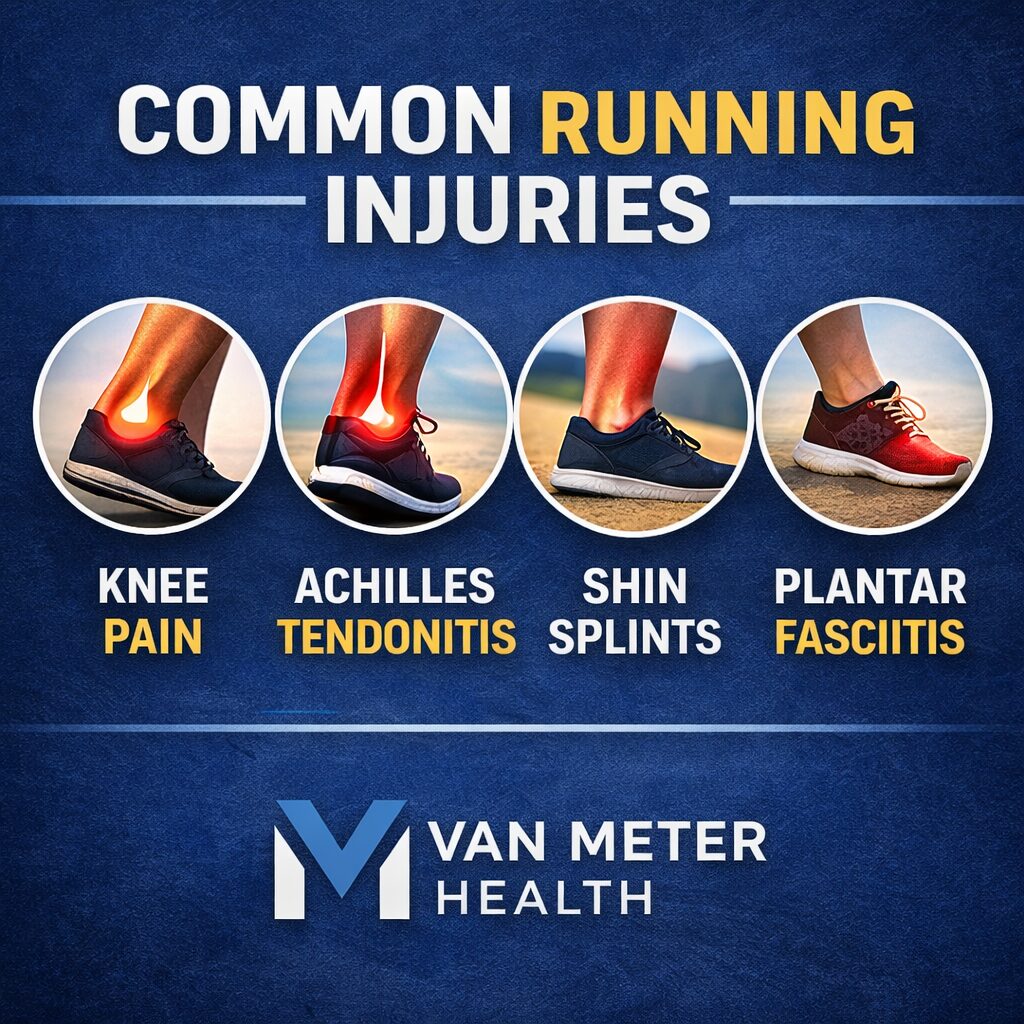
Especially this time of year, it’s really common to feel a little sore or stiff when you start getting back into running.
That might look like:
That alone doesn’t automatically mean anything is seriously wrong.
Your body is supposed to respond to activity.
The bigger issue is when something starts going from: “a little annoyed” to “this is clearly not handling load well.”
That’s usually where people get themselves into trouble.
A lot of running pain is more manageable if it behaves well.
Generally speaking, it’s usually a better sign if the discomfort:
That pattern matters. A lot.
There are definitely times where trying to tough it out is not the move.
If it feels sharp, stabbing, or like something suddenly “grabbed,” that’s usually not one to just test and hope for the best.
If you’re limping, shortening your stride, landing weird, or clearly running around the issue, you’re usually setting yourself up for a second problem on top of the first one.
Especially in areas like the shin or foot.
If it feels very specific, deep, and impact-sensitive, that deserves a little more respect than general muscle soreness.
A lot of people say:
“Well it didn’t hurt that bad while I was running, so I figured it was fine.”
But then later that day or the next morning it’s way worse.
That still counts.
What happens after the run matters just as much as what happens during it.
This is where people get frustrated.
They think their only options are:
And honestly, a lot of the time, neither one is the best answer.
Usually there’s a middle ground.
Sometimes the better move is just to adjust things for a bit.
That might mean pulling back on:
A lot of running injuries don’t necessarily need zero activity. They usually need better dosage.
That’s a big difference.
This time of year is kind of a perfect storm for people doing too much too fast.
A few common reasons:
Even if you don’t feel like you’re “training hard,” your overall load usually jumps this time of year.
You’re suddenly:
Sometimes it’s not just the running. It’s everything else stacked on top of it.
This happens every year. You finally get a nice week and suddenly you feel like doing all the things again. Your motivation comes back really fast.
Your tissues… not always as fast.
That’s how calves, Achilles, knees, feet, and hips start getting irritated.
If you’ve been on a treadmill all winter — or not running much at all — outdoor running can hit differently.
Usually more hills.
More uneven surfaces.
More calf and Achilles load.
More variability.
Sometimes that change alone is enough to stir something up.
Nothing fancy here. Just the stuff that actually tends to matter.
This is probably the biggest one.
Most spring running issues don’t happen because of one terrible run.
They happen because:
“I felt good… so I kept adding.”
Try not to increase all of these at once:
That’s usually where people get themselves into trouble.
You don’t need some elaborate 25-minute routine.
But hopping out of the car and trying to run your old pace immediately probably isn’t helping either.
Even 5 minutes can go a long way.
Something simple like:
That’s enough for a lot of people.
As it gets warmer, your body has to work harder even if your pace stays the same.
That means:
A lot of people think they’re just “out of shape” when really they’re just not adjusted to the heat yet.
Running tolerance is also affected by:
Sometimes the issue isn’t that running is bad.
Sometimes your body just doesn’t have enough room to recover from everything else right now.
You do not need some crazy gym program.
But having at least a little strength work in the mix for:
usually helps a lot more than people think.
You do not need to wait until you can barely run or can’t run at all.
It’s worth getting looked at if:
A lot of runners wait too long because they assume they’re going to be told:
“Just stop running.” That’s always our last resort.
Most of the time, the goal is to figure out:
Not every ache means you need to stop running.
But not every ache should be ignored either.
A better question than:
“Can I run through this?” is: “How is this responding to running?”
That usually tells you a lot.
If it’s mild, stable, and settles down well, it may be something you can work through.
If it’s getting worse, changing your mechanics, lingering, or affecting day-to-day life, it’s probably worth addressing sooner rather than later.
If you’re dealing with something and you’re not sure whether it’s safe to keep running on, we’re always happy to help.
You can book an appointment through our online scheduler linked here.